Stroke Warning Signs: BE FAST and Why the First 4.5 Hours Matter
BE FAST is a six-letter checklist for spotting a stroke: Balance, Eyes, Face, Arm, Speech and Time. If any one of the first five appears suddenly, the last letter is the instruction: call 108 and get to a hospital that can scan and treat stroke at any hour. The reason for the hurry is concrete. Clot-dissolving medicine for the most common type of stroke works best when it is given early, and in most cases only within 4.5 hours of the moment the person was last seen normal. This guide explains each letter, what those 4.5 hours buy, what can still be done after them, and what to do in the first few minutes at home.
Suspect a stroke right now? Call 108, then jump to what to do while you wait.
- BE FAST adds Balance and Eyes to the older FAST test. In one US hospital study, FAST alone missed 14.1% of ischaemic strokes; adding balance and vision symptoms cut that to 4.4% (Aroor et al., Stroke, 2017).
- The clot-dissolving drug’s benefit falls as the hours pass. In a pooled analysis of 6,756 patients, it clearly helped when given within 4.5 hours, and the benefit was no longer statistically clear after that (Emberson et al., The Lancet, 2014).
- In India’s national stroke registry, only 20.1% of 34,792 patients reached hospital within 4.5 hours, and only 4.6% of ischaemic stroke patients received clot-dissolving treatment (Mathur et al., International Journal of Stroke, 2026).
- Missing 4.5 hours does not mean nothing can be done. Selected patients with a blocked large artery can still benefit from clot removal (thrombectomy) up to 24 hours.
- Call 108, note when the person was last seen normal, give no aspirin, food or water before a brain scan, and skip home remedies.
What Does BE FAST Stand For?
Each of the first five letters is a symptom you can check in under a minute, without any equipment. The key word throughout is sudden. A stroke switches off part of the brain within seconds or minutes, so the change is abrupt rather than gradual.
| Letter | What to look for | Quick check |
|---|---|---|
| B: Balance | Sudden loss of balance, dizziness, staggering, or one leg giving way | Do not make them stand or walk to test this. Ask if they suddenly feel dizzy or unsteady, and watch whether they sway or lean to one side while sitting |
| E: Eyes | Sudden blurred, double or lost vision in one or both eyes | Ask them to count fingers you hold up on each side |
| F: Face | One side of the face droops or feels numb | Ask them to smile. Is the smile uneven? |
| A: Arm | Weakness or numbness in one arm (or leg) | Ask them to raise both arms for ten seconds. Does one drift down? |
| S: Speech | Slurred speech, wrong words, or trouble understanding | Ask them to repeat a simple sentence in their own language |
| T: Time | Any one of the above, even if it fades | Call 108, then note the time they were last seen normal |
Why were Balance and Eyes added to FAST?
FAST was designed around the most common stroke pattern: a blocked artery on one side of the brain, causing face, arm and speech problems. Strokes at the back of the brain, which controls balance and vision, can leave the face and arm completely normal. Researchers at the University of Kentucky reviewed 736 patients with ischaemic stroke and found that 14.1% had none of the FAST symptoms when they arrived. Of those missed patients, 70% had either balance trouble or visual symptoms. Adding those two checks reduced the proportion of missed strokes to 4.4% (Aroor, Singh and Goldstein, Stroke, 2017). It was a single-hospital, retrospective study, so the exact numbers may differ elsewhere, but the lesson holds: sudden dizziness with unsteadiness, or sudden loss of vision, is not something to sleep off.
Which stroke symptoms can BE FAST still miss?
No checklist catches everything. Treat these as emergencies too, even if BE FAST looks normal:
- A sudden, severe headache, often described as the worst headache of one’s life, especially with vomiting, a stiff neck or fainting. This can signal bleeding in the brain, sometimes from a burst aneurysm.
- Sudden confusion or trouble understanding simple instructions.
- Sudden numbness or weakness of one leg, or of the whole of one side of the body.
- Symptoms that come and go. A transient ischaemic attack (TIA, often called a mini-stroke) can resolve within minutes, but it is a warning that a larger stroke may follow. It needs the same urgent assessment.
Why Do the First 4.5 Hours Matter So Much?
Because brain tissue starved of blood dies quickly, and the main medicine for clot-related stroke stops being clearly useful after about 4.5 hours. Most strokes, roughly six in ten in India’s national registry, are ischaemic: a clot blocks an artery feeding the brain (Mathur et al., 2026). A widely cited calculation estimates that in a typical large untreated ischaemic stroke, the brain loses about 1.9 million nerve cells every minute (Saver, “Time is brain: quantified”, Stroke, 2006). Doctors summarise this as “time is brain”.
Intravenous thrombolysis, treatment with a clot-dissolving drug given through a vein, can reopen the artery and rescue brain tissue that has not yet died. The 4.5-hour limit comes from trials. The European ECASS III trial showed that alteplase given 3 to 4.5 hours after onset still improved recovery: 52.4% of treated patients had a favourable outcome against 45.2% on placebo (Hacke et al., New England Journal of Medicine, 2008). A later pooled analysis of nine trials found the benefit shrank steadily with delay:
Put simply, among patients treated within three hours, 33% of those given alteplase recovered with little or no disability, against 23% of those who were not (259 of 787 against 176 of 762; Emberson et al., 2014). Between three and 4.5 hours the advantage was much smaller, and after that it was no longer reliable. The drug also carries a real risk of bleeding in the brain: in the same analysis, symptomatic bleeding occurred in 6.8% of treated patients against 1.3% of controls (Emberson et al., 2014). Within the window, the expected benefit outweighs that risk for eligible patients. Beyond 4.5 hours, for patients selected only by the clock and a plain CT scan, the balance tips the other way; the exceptions described below depend on advanced imaging. That is why a CT scan must come first, to rule out a bleed, and why every minute before the scan counts.
What changed in the 2026 stroke guideline?
The American Heart Association and American Stroke Association published a new acute ischaemic stroke guideline in January 2026, replacing the 2018 guideline and its 2019 update (Prabhakaran et al., Stroke, 2026). In the AHA’s own summary, it endorses either alteplase or tenecteplase within the 4.5-hour window. Tenecteplase is given as a single injection rather than an hour-long drip, which saves time in the emergency room. A guideline review by Rosalind Franklin University’s College of Pharmacy also describes thrombolysis in selected patients up to 9 hours after onset, depending on brain imaging findings (HelixTalk, 2026). These extended options depend on specialised imaging and are decided case by case. They are not a reason to wait.
What If You Miss the 4.5-Hour Window?
Come to hospital anyway. When a stroke is caused by a clot in one of the large arteries of the brain, an interventional neuroradiologist can often remove it directly. A thin catheter is passed from an artery in the groin or wrist up to the brain, and the clot is pulled out. This is called mechanical thrombectomy. In the DAWN trial, selected patients treated with thrombectomy between 6 and 24 hours after they were last seen well achieved functional independence at 90 days in 49% of cases, against 13% with medical treatment alone (Nogueira et al., New England Journal of Medicine, 2018).
Thrombectomy needs a cath lab and a trained team, and not every patient qualifies. Even when neither clot treatment is possible, early admission still matters: stroke-unit care, swallowing checks before the first sip of water, control of blood pressure and sugar, and early rehabilitation all affect recovery. A stroke that has “settled” by the next morning still needs urgent investigation, because the risk of a second stroke is highest in the days that follow.
How Many Stroke Patients in India Reach Hospital in Time?
Very few. The Indian Council of Medical Research’s National Stroke Registry Programme tracked 34,792 stroke cases at 30 hospitals between 2020 and 2022. Only 20.1% of patients arrived within 4.5 hours of symptom onset. Thrombolysis was given to 4.6% of ischaemic stroke patients and thrombectomy to 0.7%. Three months after the stroke, 27.8% of patients had died and another 29.7% were living with significant disability. Hypertension was the most common risk factor, present in 74.5% of patients (Mathur et al., International Journal of Stroke, 2026).
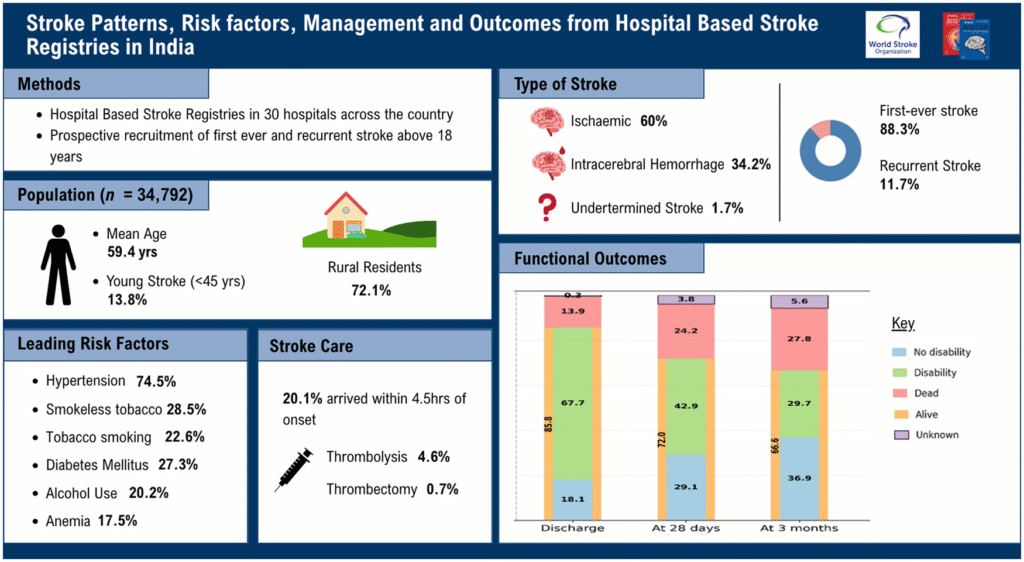
Those numbers point to the gap that matters most. Effective treatment exists, including in Mangaluru, but in the national registry four in five patients arrived after the 4.5-hour window for clot-dissolving medicine. Many of the minutes that families can save are lost before anyone reaches a hospital: waiting to see if the weakness passes, calling relatives first, stopping at a nearby clinic without a CT scanner, or arranging private transport. Recognising BE FAST and going straight to a stroke-ready hospital is the single biggest thing a family can do.
What Should You Do in the First Few Minutes?
- Call 108 (or 112) for an ambulance, tell the call-taker you suspect a stroke, and ask to be taken to a stroke-ready hospital. If you must drive, go straight to a hospital that offers 24-hour CT scanning and stroke treatment, not to the nearest clinic.
- While you wait, note the time the person was last seen normal. If they woke up with symptoms, that time is when they went to sleep. Doctors will ask for it before anything else.
- Keep them safe. Lay them on their side if drowsy or vomiting, loosen tight clothing, and stay with them.
- Give nothing by mouth. No aspirin, no water, no food, no tablets. Aspirin can worsen a bleeding stroke, and a stroke can affect swallowing, so water or food can enter the lungs.
- Skip home remedies. Pricking fingertips, massage, or waiting for a local healer wastes minutes that cannot be recovered.
- Bring their medicines or a photo of the prescriptions, especially blood thinners, sugar and blood pressure tablets.
Stroke Care at First Neuro Hospitals, Mangaluru
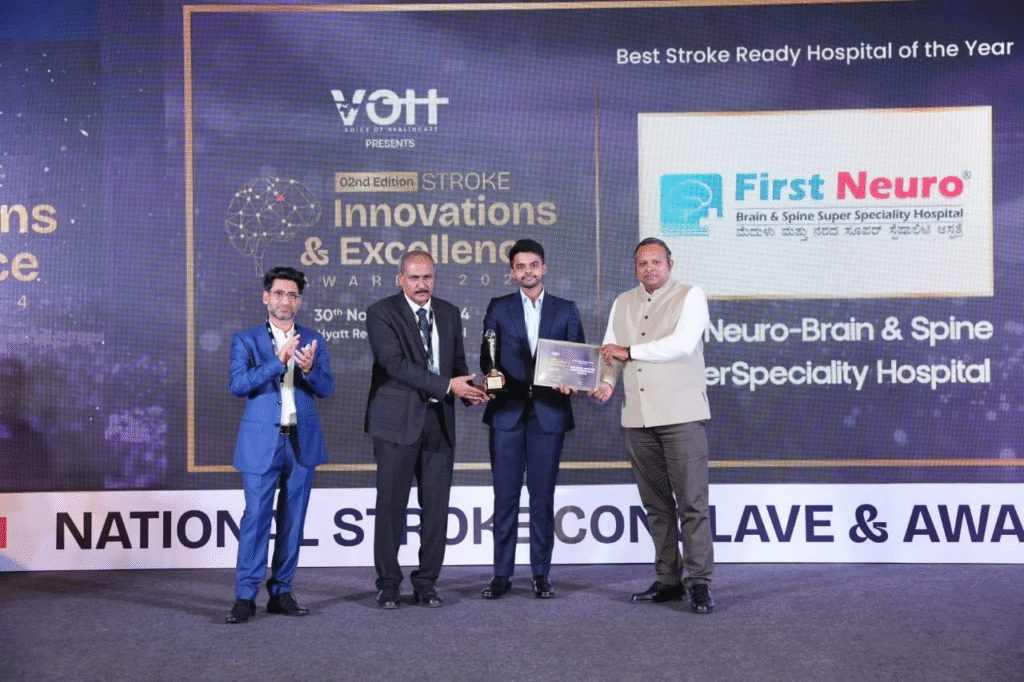
First Neuro Hospitals in Padil, Mangaluru, is a dedicated brain and spine hospital and is accredited as an Advanced Stroke Centre by the Quality and Accreditation Institute (QAI). In November 2024 it received the Best Stroke Ready Hospital of the Year award from Voice of Healthcare in association with the Indian Stroke Association (award announcement).
The equipment needed for each step of acute stroke care sits under one roof:
- Scan first. A Wipro GE Revolution Aspire CT scanner shows within minutes whether there is bleeding in the brain, and a Siemens Magnetom Amira 1.5 Tesla MRI is also on site.
- Treat the clot. Neurologists decide on clot-dissolving medicine. For large-artery blockages, interventional neuroradiologist Dr. Neha Choudhary (DM, Neuroimaging and Interventional Neuroradiology, PGIMER Chandigarh), whose special interests include mechanical thrombectomy, works in the hospital’s Siemens Artis Zee cath lab.
- Protect the brain afterwards. The neuro ICU is staffed 24×7 by neuro-anaesthetists and neuro-trained nurses.
- Rebuild function. The neuro-rehabilitation team starts therapy once the patient is stable.
You can contact the stroke team through our stroke treatment page and see the scanners and cath lab on the infrastructure and technology page.
Suspect a stroke right now?
Call 108 and ask for a stroke-ready hospital. If you are coming to First Neuro, call us on the way so the team can prepare.
Can You Lower Your Risk of Stroke?
Yes, and blood pressure is the place to start. Three in four patients in India’s stroke registry had hypertension (Mathur et al., 2026), and many people with high blood pressure feel perfectly well until the day of the stroke. Regular blood pressure, sugar and cholesterol checks, treating an irregular heartbeat if a doctor finds one, stopping tobacco, cutting down on alcohol and salt, and staying active all lower the risk. If you have a family history of stroke or several risk factors, one of our health check packages is a sensible start.
Frequently Asked Questions
Is BE FAST different from FAST?
BE FAST is FAST with two extra checks at the start: Balance and Eyes. They help catch strokes in the back of the brain, which can cause dizziness, unsteadiness or sudden vision loss without any face or arm weakness.
What should I do if the stroke symptoms disappear?
Call 108 and go to hospital immediately, even if the person now seems normal. Symptoms that fade within minutes may be a transient ischaemic attack (TIA), but they can also return as a full stroke, and the risk is highest in the hours and days that follow. Urgent tests and treatment can prevent it.
Should I give aspirin to someone having a stroke?
No. Until a CT scan shows whether the stroke is caused by a clot or by bleeding, aspirin may do harm. Give nothing by mouth, and let the hospital team decide on medicines after the scan.
Is the “golden hour” the same as the 4.5-hour window?
Not exactly. The 4.5-hour window is the usual time limit for clot-dissolving medicine. “Golden hour” is a shorthand for the earliest part of that window, when treatment gives the best results. In practice both mean the same thing for families: leave for hospital immediately.
Can young people have a stroke?
Yes. Stroke is more common after 60, but it also strikes people in their 30s and 40s. Never dismiss BE FAST symptoms because someone is young.
Learn the Letters Before You Need Them
Most families meet a stroke without warning, at home, with no doctor in the room. The decisions made in the next half hour largely decide how much treatment is still possible. Teach BE FAST to the people you live with, save 108 and the hospital’s number in your phone, and remember three things: call 108, note when the person was last seen normal, and give nothing by mouth. A sudden, severe headache is an emergency too: call 108 first. For questions about stroke prevention, meet our neurology team.
First Neuro Hospitals
Kannur Village, Padil Post, Mangaluru 575007, Karnataka
Please note: this article is general health information and not a substitute for emergency care or a doctor’s assessment. If you think someone is having a stroke, call 108 or 112 immediately. Treatment decisions, including eligibility for thrombolysis or thrombectomy, are made by the treating stroke team after examination and brain imaging.